Recently, Professor Liu Debao's team from the School of Materials Science and Engineering in our university, led by young faculty member Gao Jingjun, in collaboration with Professor T. Gloriant of the French National Centre for Applied Sciences, published an article entitled "Grain size dependent martensitic twinning behavior in superelastic Ti-20Zr-12Nb-2Sn alloy: A comparative study" in the international journal Acta Materialia. The School of Materials Science and Engineering in Tianjin University of Technology is the first affiliated institution for this work. Acta Materialia is a top journal in the field of metallic materials. According to the Chinese Academy of Sciences' SCI journal ranking system, this journal has consistently ranked in the top quartile of the Chinese Academy of Sciences, with an average acceptance rate of "very difficult." This research was strongly supported by the National Natural Science Foundation of China, the National Postdoctoral Science Foundation of China, and the Tianjin Natural Science Foundation.
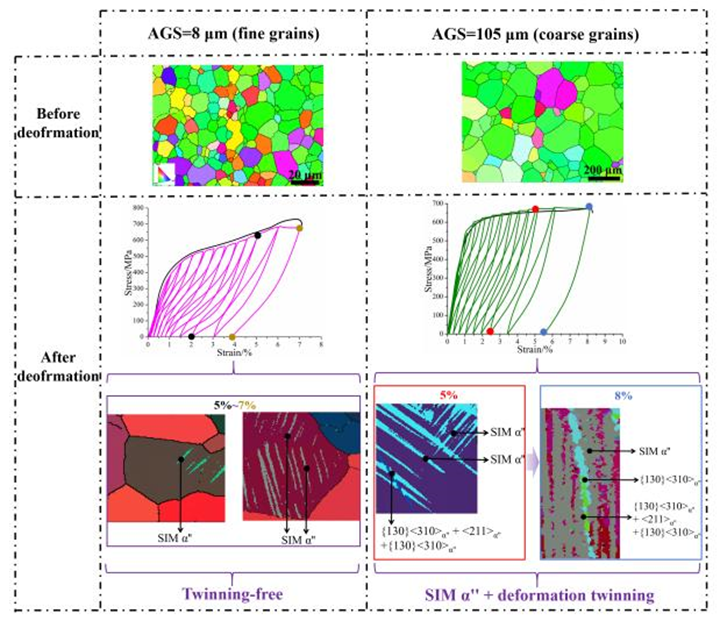
It is widely accepted in the academic community that grain refinement strategies can effectively enhance the superelasticity of metastable β-titanium alloys. However, the influence of grain size on the deformation mechanisms of superelastic alloys has remained unclear. Using the newly developed Ti-20Zr-12Nb-2Sn (at.%) alloy as a model, Gao Jingjun, for the first time, demonstrated through material characterization techniques such as electron backscatter diffraction (EBSD), transmission electron microscopy (TEM), and in situ synchrotron X-ray diffraction (in situ SXRD) that grain refinement can effectively inhibit the activation of deformation twinning, thereby achieving the maximum martensitic transformation strain.
The publication of this work is not only a major breakthrough for our university in the field of biomedical titanium-based shape memory alloy research, but also an effective practice of promoting scientific research strategic cooperation between China and France.