Recently, the paper titled Identity-Guided Collaborative Learning for Cloth-Changing Person Re-Identification (IGCL), authored by Professor Zan Gao from Tianjin University of Technology, has been accepted for publication in IEEE Transactions on Pattern Analysis and Machine Intelligence(IEEE TPAMI)—one of the world’s most prestigious journals in artificial intelligence, pattern recognition, computer vision and machine learning.
Recognized as the top-ranked A-level journal in the artificial intelligence category by the China Computer Federation (CCF), IEEE TPAMI is regarded as the leading publication in computer vision and pattern recognition. It boasts a five-year average impact factor of 26.7. According to the latest Google Scholar Metrics, IEEE TPAMI ranks first among all journals in computer engineering, electronic engineering and artificial intelligence, with an h5-index of 165. The journal publishes only around 200 papers annually, focusing on original and high-impact research in AI, pattern recognition, computer vision and machine learning, making it one of the most influential academic journals in these fields.
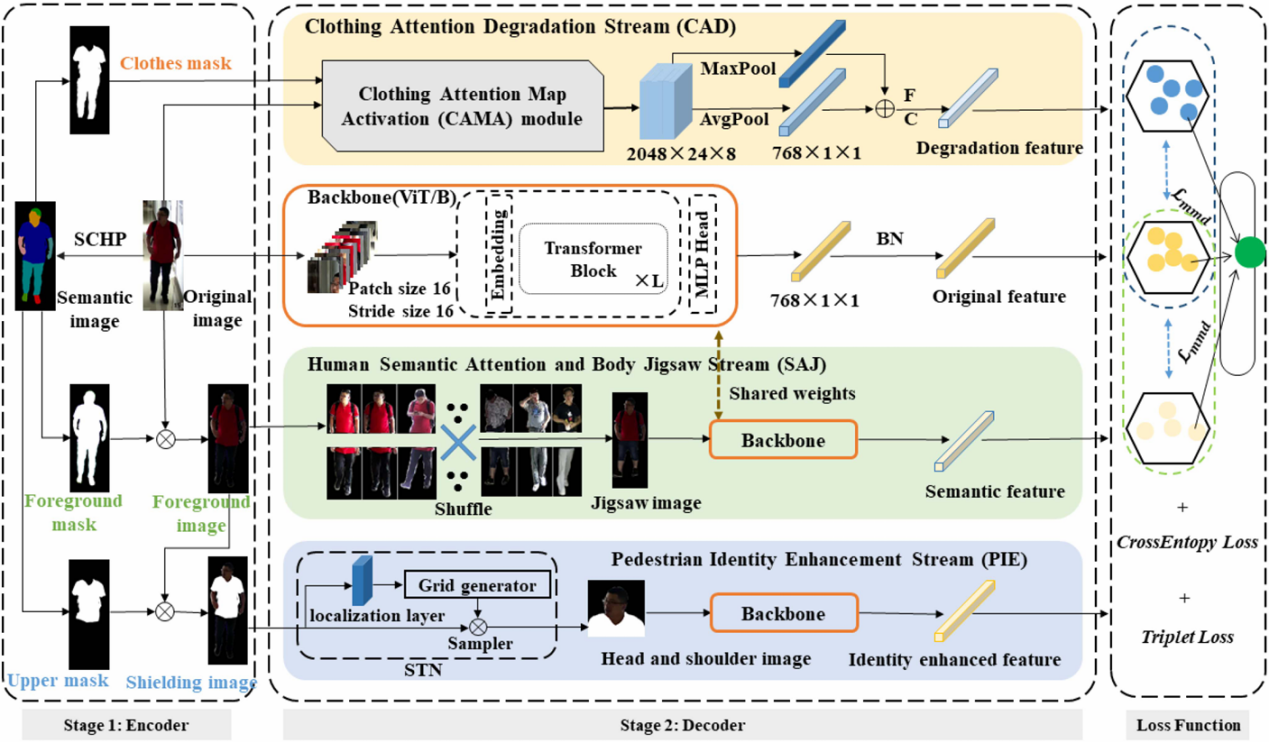
This study addresses the challenging task of cloth-changing person re-identification (ReID) by exploring complex intra- and inter-class variations of pedestrian appearances and learning identity representations that are robust to clothing changes. The proposed Identity-Guided Collaborative Learning (IGCL) framework introduces a novel end-to-end joint learning paradigm, which integrates three key components: the Clothing Attention Degradation Stream (CAD), the Human Semantic Attention and Body Jigsaw Stream (SAJ), and the Pedestrian Identity Enhancement Stream (PIE). Together, these modules collaboratively learn clothing-invariant identity features. Extensive experiments demonstrate the superiority of the proposed IGCL framework, showing that the learned features possess stronger representational and discriminative abilities while being less correlated with confounding factors such as clothing changes.