Recently, the School of Computer Science and Engineering achieved notable advances across multimedia technology, computer vision, and machine learning. Nine research papers have been accepted by three top-tier international academic conferences—ACM MM, ICCV, and ICML—demonstrating the University’s strong momentum and competitive strength in frontier technological research.
At ACM MM 2025, the School of Computer Science and Engineering achieved seven paper acceptances across diverse research fronts, including federated learning, multimedia generation, and dynamic scene reconstruction. Among them, Associate Professor Fan Qi’s team proposed the federated unlearning framework F2GU, which, for the first time, enables both privacy protection and efficient forgetting of user data in facial generative models. Professor Zan Gao’s team introduced a Lightweight Relational Proposal Network (LRPN), addressing the challenge of effectively modeling the relationships between proposals while significantly reducing model parameters. Associate Professor Chen Li’s team developed FluidGS, a framework that leverages physics-aware Gaussian primitives to substantially improve the efficiency and visual quality of dynamic fluid reconstruction from sparse viewpoints. Professor Fan Shi’s team proposed LFMamba, a light field salient object detection framework that achieves high-precision detection of salient regions in complex scenes.
At the ICCV 2025 conference, Professor Feifei Zhang’s team focused on the task of continual long-tailed visual question answering and proposed a dual-balancing mechanism that effectively addresses prototype drift and feature drift. This work provides a new perspective for tackling long-tailed distribution challenges in multimodal learning tasks.
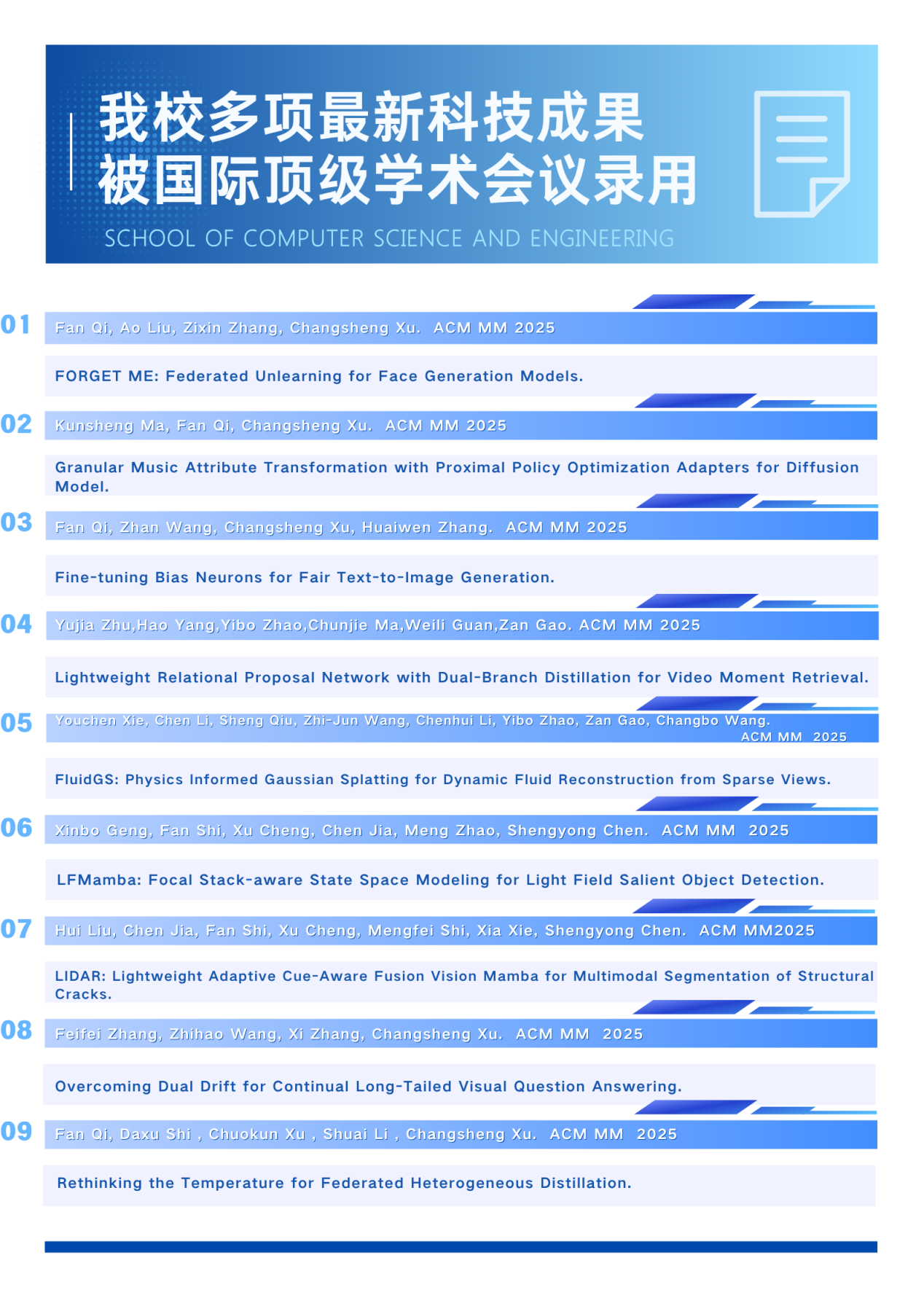
At the ICML 2025 conference, Associate Professor Fan Qi’s ReT-FHD framework revisited the temperature design issue in federated heterogeneous distillation. By introducing a multi-layer elastic temperature mechanism and a class-aware strategy, the framework significantly improves model performance while reducing both computational and communication overhead.
The University remains closely aligned with national strategic needs and is committed to advancing innovative research in intelligent technologies and computer science. Moving forward, the University will continue to deepen both fundamental and applied research, cultivate more innovative talents with a global vision, and contribute to the nation’s scientific and technological development.