Recently, the research team led by Professor Shougen Yin and Professor Huanqi Cao from the School of Materials Science and Engineering at Tianjin University of Technology (TUT) has achieved a major breakthrough in perovskite solar cells. Their findings, entitled ‘Reactive reconstruction and embedded passivation of heterointerfaces for intrinsically stable perovskite photovoltaics’, were published in Science Advances, a top-tier international journal. The first author is Zhixin Ren, a Ph.D. candidate at the School of Materials Science and Engineering. This landmark achievement in the new energy field provides critical theoretical support and technological reserves for the industrial application of perovskite photovoltaics.
Perovskite solar cells offer compelling advantages such as high power conversion efficiency and low fabrication cost, positioning them as a leading next-generation photovoltaic technology. However, insufficient device stability has remained a critical bottleneck hindering their commercialization. Studies have shown that ion migration at internal interfaces within the perovskite material is one of the primary causes of performance degradation. Conventional interfacial passivation strategies largely depend on weak interactions, such as coordination bonds and hydrogen bonds, which fail to effectively suppress ion migration, leaving devices susceptible to efficiency loss during long-term operation.
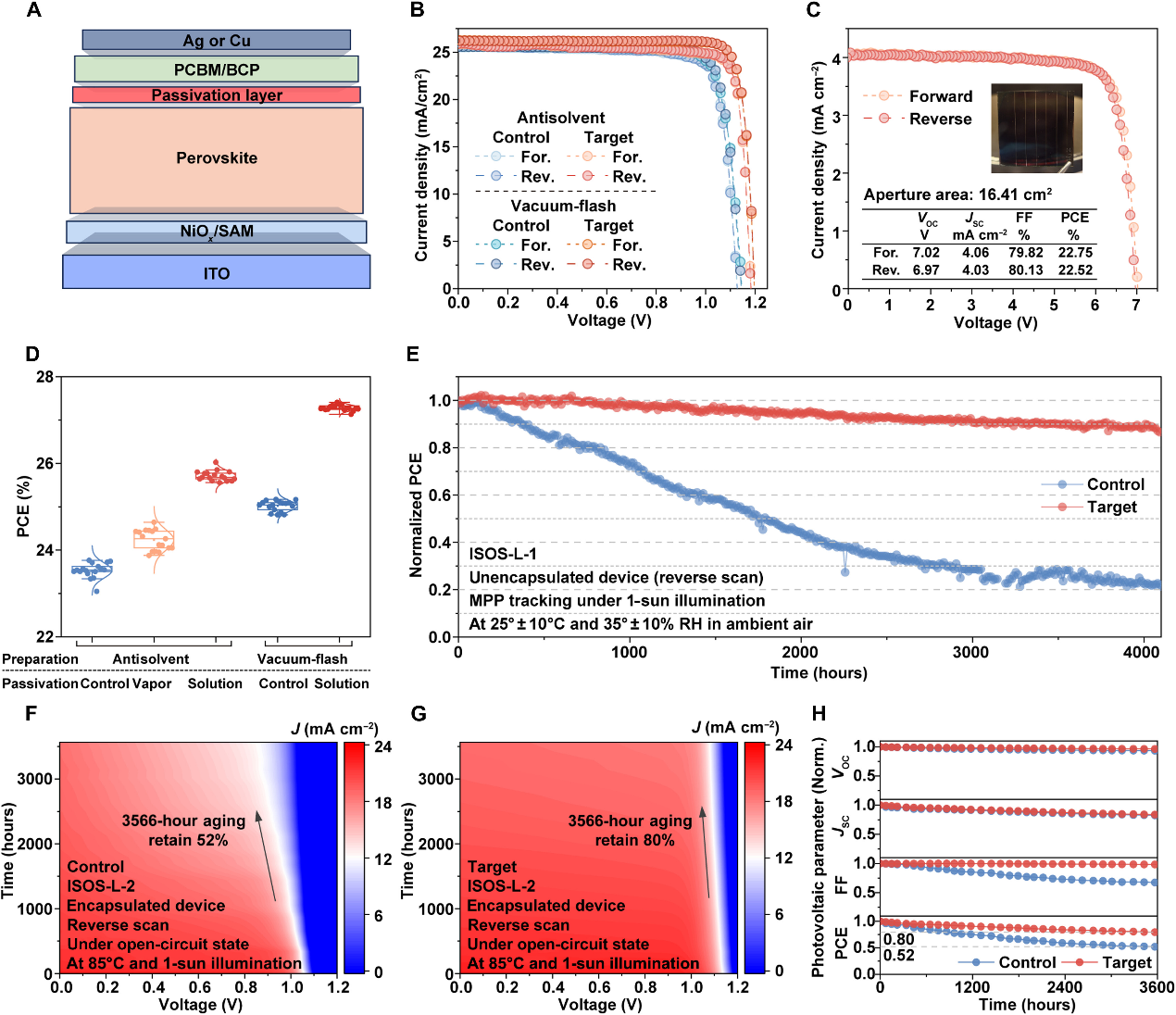
To tackle this well known challenge, the team collaborated with Professor Cong Chen of Hebei University of Technology and Dr. Jinzhao Li from the Central Research Institute of State Power Investment Corporation to conduct joint research. They innovatively proposed a synergistic strategy of ‘reactive reconstruction and embedded passivation’. A novel functionalizedbulkyanionic passivator, CsP3C, was designed and introduced at the heterointerface between the perovskite layer and the charge transport layer. This approach induces a chemical reactive reconstruction on the perovskite surface, achieving in situ reconstruction of the interfacial lattice and forming robust chemical bonds. Consequently, ion migration pathways are effectively blocked, significantly enhancing the operational stability of the devices under harsh conditions such as continuous illumination and elevated temperatures.
Perovskite solar cells fabricated using this strategy delivered outstanding overall performance: a power conversion efficiency of 27.28%; unencapsulated devices retained 87% of their initial efficiency after 4,092 hours of continuous maximum power point tracking(ISOS-L-1); and encapsulated devices maintained 80% of their initial efficiency after 3,566 hours at 85°Cand 1-sunillumination under open-circuitcondition(ISOS-L-2). These performance metrics have reached an internationally advanced level, providing a new technical paradigm for designing long-lifetime perovskite solar cells.
This research was supported by the National Key R&D Program of China project ‘Research on the Forms, Design Methods, and Weathering Resistance of Photovoltaic Modules for Nearshore Floating New Photovoltaic Systems’, led by Professor Jijian Lian of TUT. In response to the national dual carbongoals and the pressing demands of marine energy development, this achievement expands the application prospects of perovskite solar cells into complex marine environments characterized by high humidity, high salinity, intense UV irradiation, and long-term dynamic loads. It fully demonstrates the university’s deep disciplinary foundations and interdisciplinary collaborative innovation capacity in new energy materials, and highlights the ‘Tianli commitment’,the translation of application-oriented basic research into service for major national engineering needs.